
Futurist-in-Residence Program
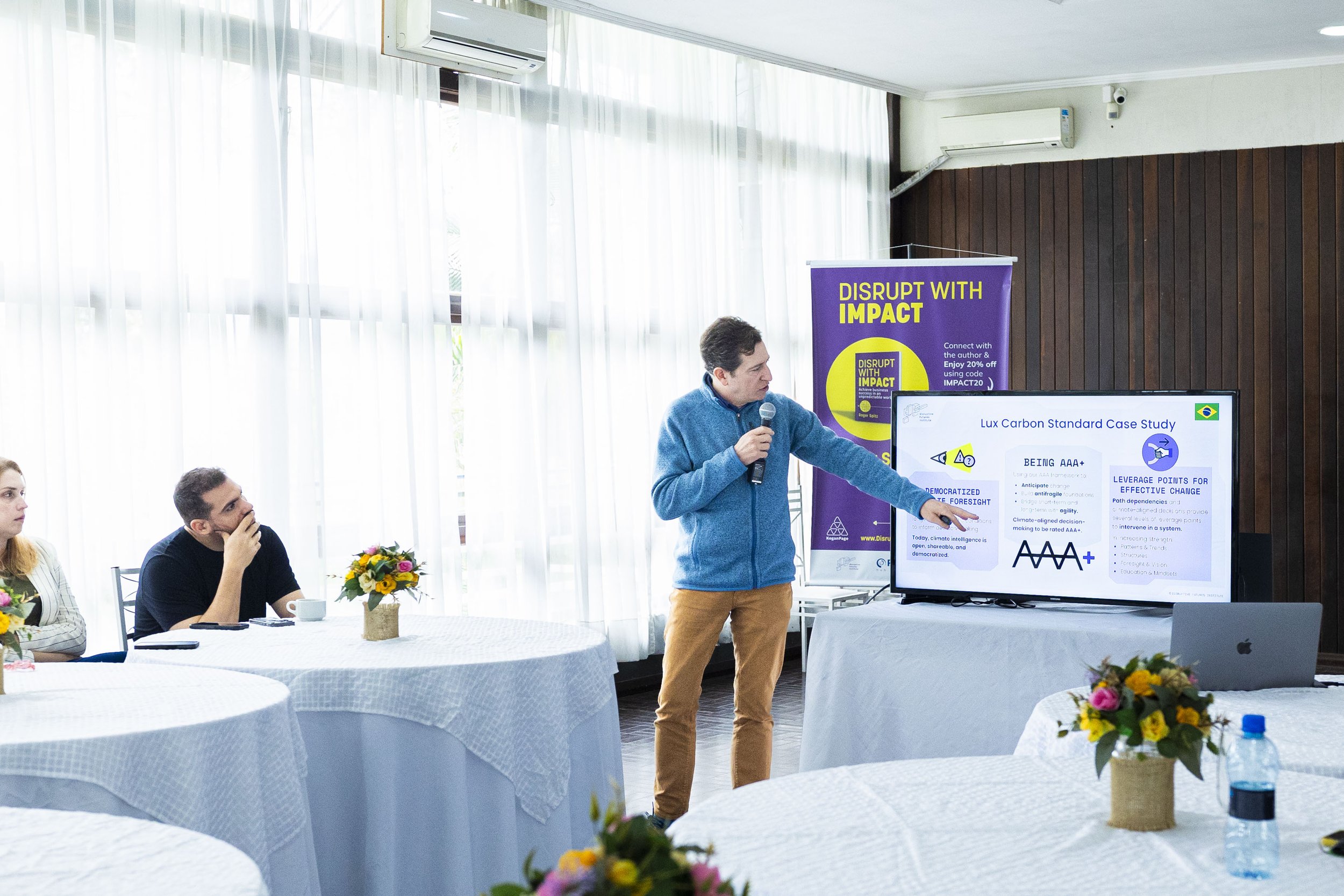
Roger Spitz (Futurist-in-Residence) with Lux Carbon Standard Team (Blumenau, Brazil). Photo LuxCS / GrupoVex
Build Your Organization’s Foresight Capabilities

Don’t have a dedicated in-house foresight function? Our Futurist-in-Residence program can help.
At the Disruptive Futures Institute, we excel at helping organizations build internal capabilities in strategic foresight, giving you the power to integrate futures intelligence into everyday decision-making.
In today’s rapidly evolving world, mastering the craft of futures thinking is an imperative. As the world’s capital for understanding uncertainty, the Disruptive Futures Institute equips organizations with a wide range of practical, real-world tools for futures preparedness.
Regardless of your team’s experience level, we will help develop your organization’s core strategic foresight capabilities with our unique methodology and proprietary frameworks.

“The embedded support of Roger Spitz at the Disruptive Futures Institute as our dedicated Futurist-in-Residence has enabled us to transform the carbon markets beyond what we could have imagined.”
Thiago Müller, Co-Founder & Chief Executive Officer, Lux Carbon Standard
Why hire a Futurist-in-Residence?
Our Futurist-in-Residence model supports your capabilities development:
Interpret early signals of change: Scan the fragments of the future already present.
Infuse futures fluency: Build futures skills and capacity to create and sustain change.
Craft futures-readiness: Foster a culture of future preparedness.
Leverage the duality of disruption: Be resilient to shocks, and create space for new opportunities to harness disruption as a springboard for sustainable value creation.
Imagine multiple future scenarios: Foresight isn’t about predicting the future, but about preparing for it. Scenario development helps you evaluate plausible opportunities and risks, to scrutinize their potential consequences and outcomes.
Anticipate stakeholder dynamics: Map and analyze broad stakeholder motivations and potential impacts to integrate their influence on future outcomes.
Achieve clarity: Inform decision-making today despite - or thanks to - deep uncertainty.

The Disruptive Futures Institute helps your organization become AAA. This requires embracing Anticipatory thinking, building Antifragile foundations, and exercising agency to maneuver with Agility in novel environments - informing decisions while reconciling the emerging present with your longer-term vision.


Ready to bring futures intelligence to your organization?
Take the first step toward developing, deploying, and scaling foresight capabilities. Request a complimentary assessment of your organization’s futures preparedness by reaching out to programs@disruptivefutures.org or clicking the button below, and learn how the Disruptive Futures Institute’s Futurist-in-Residence program can transform your organization.
Assessing Your Organization’s Futures Readiness

Traditional planning assumes a stable, predictable, and linear world. However, when many variables are unknown and their interactions unpredictable, relying solely on traditional strategic planning can be risky. The future is unmapped; you can’t rely on modelling uncertainties to deliver certainty.
In foresight, insights from historical analysis and trends are helpful, but only to provide a base. We build out different scenarios, outcomes, and possible futures which may be different from the past, where longer timeframes matter, and where next-order impacts are captured.
Thinking about long-term futures should never be to the detriment of the present. Only the present exists, so all our decisions towards longer-term futures need to be translated to the now.
Explore the following eight considerations to gauge your organization’s future readiness:
Language: The degree to which the leadership teams use future-focused language. Or, in contrast, language such as “this is impossible,” “it has never happened before,” “this is the way it is done.”
Capabilities and mindset: Organization’s awareness of futures thinking and depth of foresight capacity within leadership teams.
Timeframes: Frequency of exploring multiple futures with longer timeframes (beyond five, even ten years).
Investigating change: Processes in place to scan, monitor, and evaluate weak signals, emerging issues, and next-order implications.
Decision-making: Leadership team’s ability for sense-making and decision-making in deeply uncertain environments.
Predictability: Understanding that the planning tools used by leadership, finance, and risk management teams do not translate into predictability about the future.
Quantitative and qualitative filters: Thoughtful use of data insights and financial projections, rather than unwavering reliance to the exclusion of qualitative approaches.
Organizational structure: Decision-making processes are fluid and agile instead of centralized and hierarchical.

“The shift towards building adaptive systems and working towards transformative change is gaining momentum globally and achieving tangible results on the ground. Lux Carbon Standard (LuxCS), Brazil’s first voluntary carbon market certifier collaborated with Disruptive Futures Institute to transform the country’s carbon markets – through both financial expertise, anticipatory governance and systems thinking. Their work shaped Bill 182/2024, introducing stricter carbon credit standards while expanding access to those often disproportionately disadvantaged–local landowners and small-scale stakeholders–and ensured fairer compensation.”
– School of International Futures (SOIF), From Disruption to Transformation, December 19, 2024
Futures Capacity Building: Anticipatory Readiness Level (ARL)

Inspired by NASA’s Technology Readiness Level (TRL) framework, our Anticipatory Readiness Level (ARL) is designed to measure and monitor your organization’s anticipatory capabilities. ARL is based on a 1-to-6 scale, where higher rankings indicate more developed foresight capabilities.
We use the ARL framework to identify gaps and drive continuous learning, supported by the Disruptive Futures Institute’s foresight capacity building programs and Futurist-in-Residence offerings.

Shape the future with a more resilient tomorrow.
Reach out to programs@disruptivefutures.org or click the button below, and let’s explore how a Futurist-in-Residence can transform your organization.