

Techistential Center for Human & Artificial Intelligence

At the Techistential Center for Human & Artificial Intelligence, we conduct research, provide education, and advise on AI’s impacts, governance, and ethics, exploring the future of artificial intelligence and decision-making in our technological world. We define this new reality – the updated existential condition of the 21st century, shaped by rapidly evolving machines – as Techistentialism.
What is Techistentialism?
Today, we face both technological and existential conditions that can no longer be separated. Roger Spitz, founder of Techistential, defines this phenomenon as Techistentialism:
Techistentialism alludes specifically to the relation between technology and the nature of the human being (the latter is what existentialism studies).
Today technology is beginning to shape society by influencing decision-making and enabling manipulation at scale: At the same time, technology impedes upon the realm of our individual existence as acting agents. Decision-making is perhaps the most express manifestation of the unquestioned trust and power we place on technology. It is this paradigm shift from exclusively human decision-making to algorithmic decision-making which we believe brings about an existential challenge directed at humanity. At this intersection, we stand on the edge of our free will and our fundamental concepts of choice.
Our freedom as individuals is determined through our own choices and actions: Choice exists thanks to contingency. Computationally rational technology is no longer neutral as it drives away contingency in the circumstances of life. Contingency is the idea that possible events are uncertain; they may or may not happen, something may or may not arise. We have a choice to make regarding the use of technology. It is here that the existential dimension is confronted by the use of technology.

Articles on Techistentialism
Techistentialism argues that the existential and technological aspects of human existence are becoming inextricably linked and can no longer be separated, especially as artificial intelligence systems produce decision outcomes.
This shift is bringing about an existential challenge directed at humanity, with far-reaching choices regarding humanity's relationship with, and use of, technology. Dive deeper into Techistentialism and the move from human to algorithmic decision-making in these articles.
-

The Future of Strategic Decision-Making
Journal of Futures Studies
-
Will superstupidity be as dangerous as superintelligence?
Building a Human Resilience Infrastructure for the AI Age, Elon University (Imagining the Digital Future Center)
-
5 Strategies to Activate your Agency and Stay Relevant in the Age of AI
World Economic Forum
-
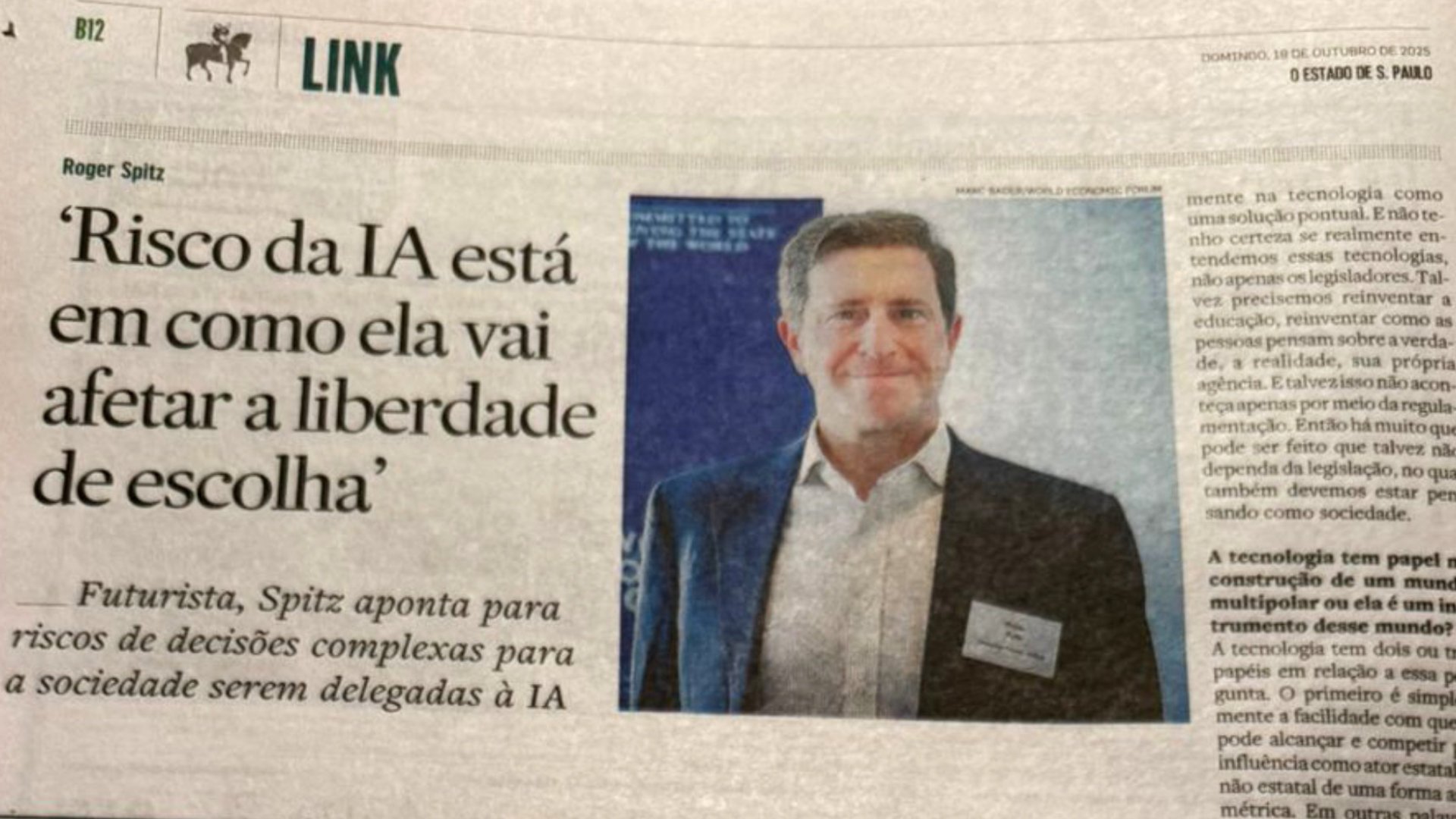
“The Existential Risk of AI Lies in How It Affects Our Freedom of Choice,” Says Futurist Roger Spitz
Estadão
Roger Spitz’s Keynotes on AI Topics

Famous for his unique keynotes, Roger Spitz blends exclusive research from the Disruptive Futures Institute with real-world case studies from Techistential. Roger’s talks empower organizations to build futures intelligence, drive systems innovation, and create sustainable value.
A renowned expert on AI, Roger coined the term ‘Techistentialism’ and is a sought-after thought leader on the future of strategic decision-making and artificial intelligence. As such, artificial intelligence and Techistentialism are featured prominently as core topics of Roger’s keynotes.
The audience will walk away with actionable tools and a mindset shift to thrive in a future where human cognition and AI are inseparable.
Interested in harnessing Roger’s AI thought leadership for your organization? Learn more on our dedicated speaking hub, or click the button below to inquire today.
Watch Roger Spitz’s keynote address on “AI Dynamics in the Boardroom” at the Annual London Global Convention of the Institute of Directors (IOD), India.
AI Insights from “Disrupt With Impact”

Roger Spitz's award-winning bestselling book, "Disrupt With Impact: Achieve Business Success in an Unpredictable World", offers an extensive focus on the future of AI and strategic decision-making.
The Future of AI and Decision-Making in an Era of Systemic Disruption. Artificial intelligence is rapidly advancing into domains once considered exclusively human. While we’ve long excelled at decision-making, our advantage may be waning.
In Disrupt With Impact, author Roger Spitz examines the defining technologies of the upcoming decade and their potential for growth, disruption, and unintended consequences. Through his concept of “Techistentialism,” Roger delves into how our very existence is being fundamentally reshaped by technology.
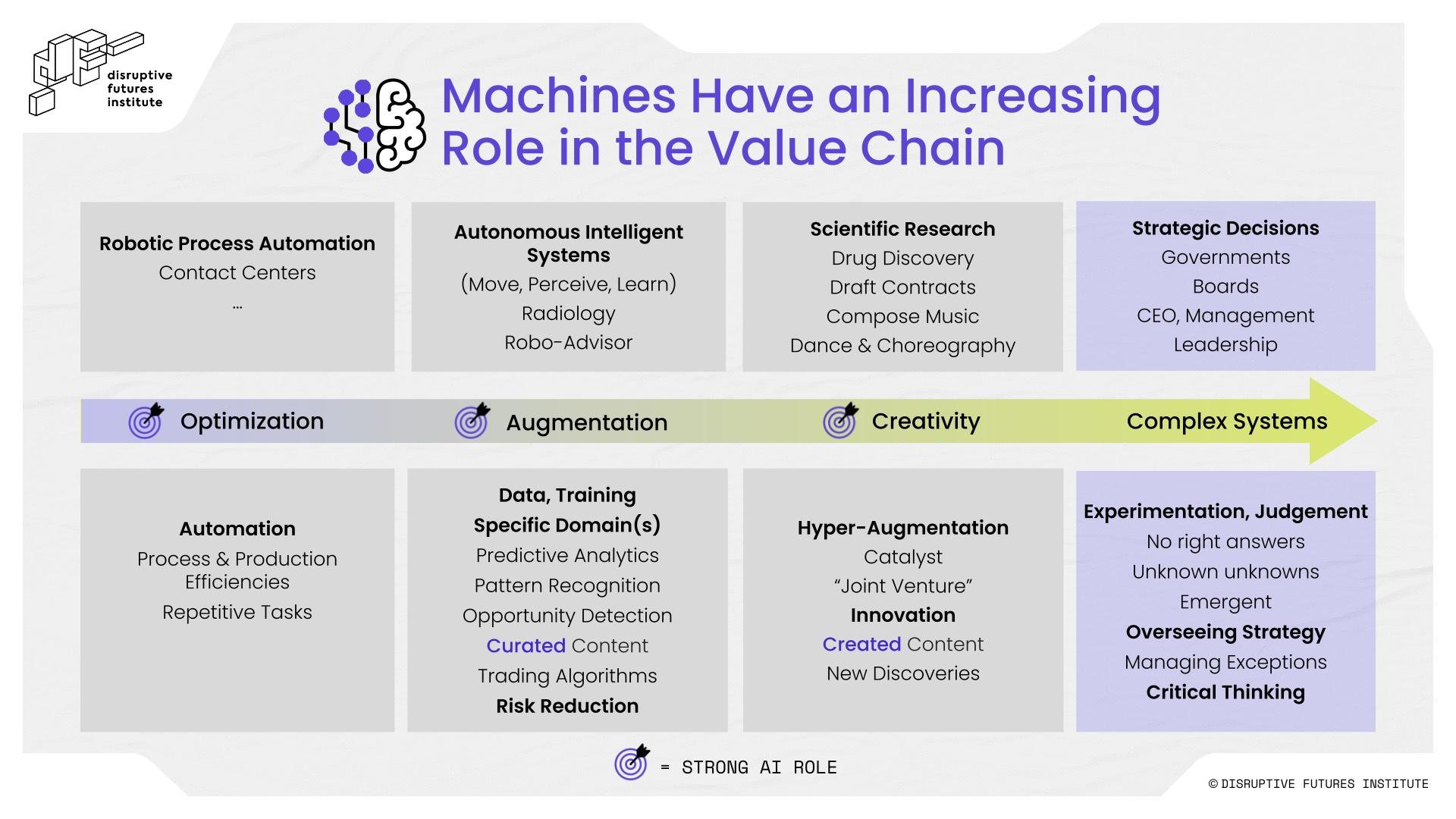
Automation, cognification, decentralization, digitization, and virtualization are altering every aspect of our lives. How can humans enhance their capabilities to remain relevant as AI advances? What higher-level functions are machines now capable of, and how quickly are they learning? What strategies can we adopt to thrive in a world where AI increasingly influences decision-making?
At the core of our investigation lies Roger’s “AAA” framework - Antifragile, Anticipatory, and Agility. These essential skills are key to decision-making in an increasingly unpredictable world where machines continuously learn.
Selected Artificial Intelligence Quotes from "Disrupt With Impact: Achieve Business Success in an Unpredictable World" by Roger Spitz

"Today, AI seems to be the answer to everything, irrespective of the question. If technology is determining outcomes on our behalf, our agency is curtailed and our choices may be beyond our control."
"Maybe the existential risk is not machines taking over the world, but rather the opposite, where humans start responding like idle machines - unable to connect the emerging dots of our UN-VICE world. (UNknown, Volatile, Intersecting, Complex, Exponential)"
"Humans need to enhance their capabilities, as machines are learning fast, gaining increasingly higher-level human functions."
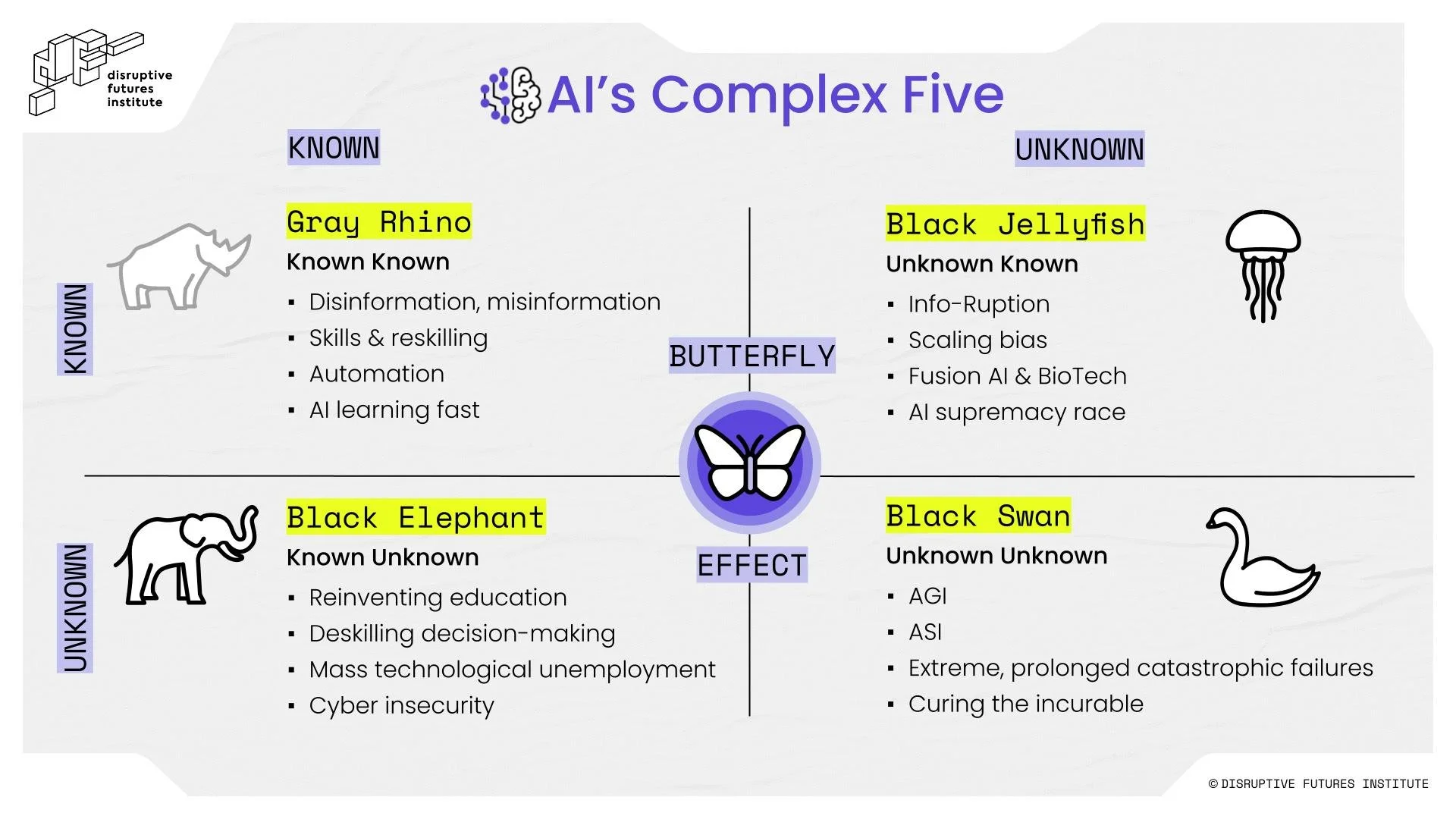
"AI is developing quickly, and the goalposts to remain relevant are constantly moving. Anything we think we know today in relation to AI will change tomorrow."
"As algorithms become the most important decision-makers in our lives, the question is not only whether we can trust AI, but whether we can trust that we understand AI well enough."
"Artists, musicians, composers and writers are all experiencing upheaval which could match that of a factory becoming automated."
"As AI continues to develop, machines could become increasingly legitimate in autonomously making strategic decisions, an area where humans currently lead."
"Thus far, humans have excelled at decision-making, but our comparative advantage may not last… Ultimately, it is an existentialist question around agency."

“This excerpt reflects on a crucial element of the human-technology relationship and even anthropology: the evolution of human autonomy… The narrative raised by the author is deep. It is distinct from the usual argument that using smartphones or devices makes you lazy in a dependency-related sense...”
— Abhivardan, Founder of Indian Society of Artificial Intelligence and Law, in his book review of Disrupt With Impact
An Existential Framework for the Future of Decision-Making in Leadership

“An Existential Framework for the Future of Decision-Making in Leadership” – Chapter in Leadership for the Future: Lessons from the Past, Current Approaches, and Future Insights, Cambridge Scholars Publishing (United Kingdom)
Chapter synopsis: Prescriptive AI presents unprecedented challenges in understanding the benefits and shortcomings of technoscientific solutions. Where the potential benefits are often promoted, critical consideration concerning the limitations of AI follows with a lag. We aim to consider the epistemic context of AI decision-making in uncertain and complex environments in relation to leadership. Our framework uses Deleuzo-Sartrean existential philosophy to draw parallels between the emergent nature of Being and decision-making, in the context of advancements in AI. While AI provides increasing insights, decision-making at leadership level and in complex environments would benefit from understanding the nature of the scientific method.
Podcast Interviews about Techistentialism
In these podcast interviews with Roger Spitz, you can listen to discussions about our research on Techistentialism:
The Decision-Making Studio Podcast Ep. 239, on How to Disrupt With Impact: Roger Spitz and host Ben Cattaneo discuss what Roger means by “Disruption 3.0”, uncertainty, AI, some of the shortcomings of our education system, and what leaders can and should be doing to disrupt with impact.
Navigating the Future of the Pacific Islands: AI Asia Pacific Institute Podcast with Roger Spitz: On this episode of the AI Asia Pacific Institute Podcast, Roger Spitz discusses Techistentialism and how it relates to the future of the Pacific Islands, from climate change to AI and human decision-making. They explore the role of digital technology and AI in both mitigating and exacerbating challenges.
Machine Ethics Podcast (Ben Byford) - Taming Uncertainty with Roger Spitz: What is AI and its role in disruption? Is AI an existential risk? How can we tell the difference between potential disaster and limitless opportunity in the age of exponential technologies?
FuturePod - The Guidebook for 21st Century Decision-Making: Two years after their initial podcast recording, Roger Spitz updates Peter Hayward’s FuturePod on the release of the Disruptive Futures Institute’s four-Volume Guidebook. They discuss how to thrive on disruption in an age of complexity and decision-making AI.
Thriving on Overload with Ross Dawson: On this thought-provoking episode of Thriving on Overload, Ross Dawson and Roger Spitz dive deep into decision-making in the disruptive 21st century. They discuss the future of strategic decision-making in the context of humanity and how technology may be taking over areas of decision-making we never thought it would. They also speak about how these topics are being unpacked in boardrooms around the world - and how many businesses are still operating under the assumption business as usual.
The In-Between Trust Podcast: Eva Simone Lihotzky speaks with Roger Spitz to explore the deep relationship between trust, agency, and technology, and why decision-making in complex systems requires more than control. This conversation invites us to rethink the foundations of leadership, the illusion of predictability, and the necessity of awareness, resilience, and anticipatory thinking in an era shaped by disruption.
FuturePod - The Essence of Being Human: Peter Hayward and Roger Spitz discuss that our true essence is found through our choices, experimentation, and creativity. These are three main ingredients to Agency, which is just one piece of Being AAA+ (comprising Anticipatory, Antifragility, Agility, Agency, and Alignment).
Pondering AI: Roger Spitz and Kimberly Nevala from SAS Institute reconcile strategy with philosophy, contemplate the influence of AI systems and the skills required to make decisions in the face of uncertainty.
Futures Intelligent Leadership Podcast with Roger Spitz and Rauli Nykänen: Roger Spitz and Rauli Westerstrand (Nykänen) discuss the implications of artificial intelligence on leadership and decision-making in complex environments. They connect the dots between AI and existential philosophy and explain the philosophical foundations of their chapter in Leadership for the Future, published by Cambridge Scholars Publishing.
The Role of a Futurist - Gartner Futures Lab Podcast: Roger Spitz and host Marty Resnick discuss the role of futurists, and elaborate upon Roger’s frameworks, such as the AAA Framework and Techistentialism.
Upskilling Human Decision Making: Roger Spitz and Pondering AI's Kimberly Nevala join forces to discuss how decision-making is changing in the age of AI. From implications to the education system to human relevance, they explore how AI will impact our futures, through the lens of Techistentialism.
“Techistentialism studies the nature of human beings, existence, and decision-making in our technological world. Today, we face both technological and existential conditions that can no longer be separated. We define this phenomenon as Techistentialism.”
— Roger Spitz